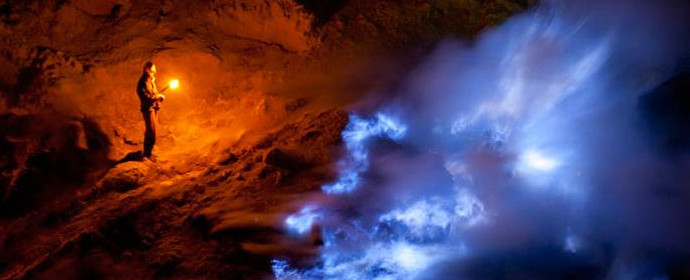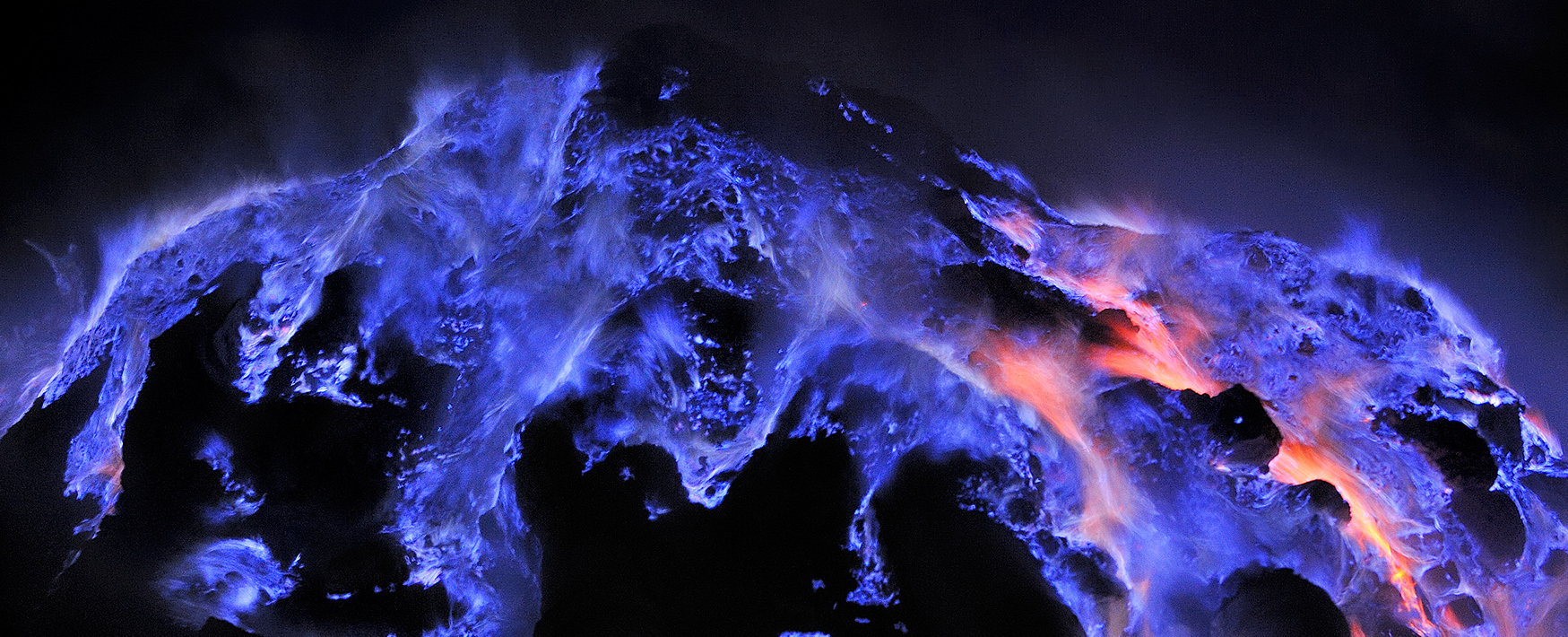
Since National Geographic mentioned the electric-blue flame of Ijen, tourist numbers increased. The phenomenon has occurred for a long time, but beforehand there was no midnight hiking. A two-hour hike is required to reach the rim of the crater, followed by a 45-minute hike down to the bank of the crater. The blue fire is ignited sulphuric gas, which emerges from cracks at temperatures up to 600 degrees Celsius (1,112 degrees Fahrenheit).
The flames can be up to 5 metres (16 feet) high; some of the gas condenses to liquid and is still ignited.It is the largest blue flame area in the world and local people refer to it as ‘Blue Fire’.
Sulfur mining at Ijen
An active vent at the edge of the lake is a source of elemental sulfur, and supports a mining operation. Escaping volcanic gases are channelled through a network of ceramic pipes, resulting in condensation of molten sulfur.[9] The sulphur, which is deep red in colour when molten, pours slowly from the ends of these pipes and pools on the ground, turning bright yellow as it cools. The miners break the cooled material into large pieces and carry it away in baskets. Miners carry loads ranging from 75 kilograms (165 lb) to 90 kilograms (200 lb), up 300 metres (980 ft) to the crater rim, with a gradient of 45 to 60 degrees and then 3 kilometres (1.86 miles) down the mountain for weighing. Most miners make this journey twice a day. A nearby sugar refinery pays the miners by the weight of sulfur transported; as of September 2010, the typical daily earnings were equivalent to approximately $13 US. The miners often receive insufficient protection while working around the volcano [10] and complain of numerous respiratory afflictions. There are 200 miners, who extract 14 tons per day - about 20 percent of the continuous daily deposit.[11]